What Is an Autologous Exosome Kit? Platelet-Derived EV Preparation Explained

An autologous exosome kit is a preparation system designed to process biological material obtained from the same individual, such as platelet-rich plasma (PRP), for the preparation of extracellular vesicle-rich biological fractions.
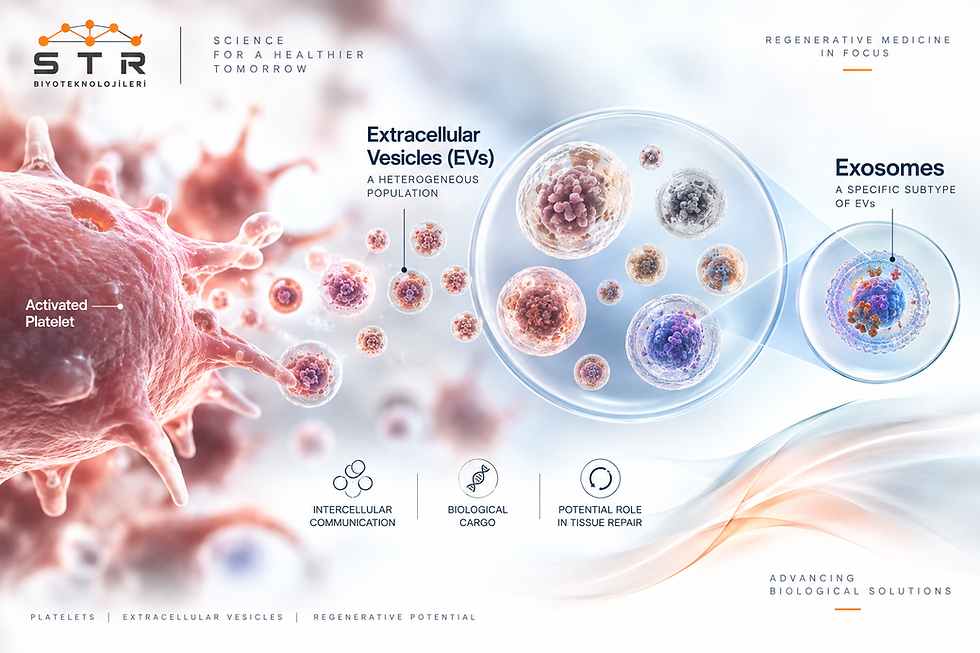
Platelets can release extracellular vesicles following activation. However, the terms extracellular vesicle and exosome are not interchangeable. According to current EV nomenclature guidelines, exosome identity requires evidence related to endosomal biogenesis; therefore, platelet-derived extracellular vesicles is often the more scientifically appropriate terminology when specific biogenesis has not been demonstrated.
What Does “Autologous” Mean?
Autologous means that the biological starting material originates from the same individual for whom the preparation is intended.
In platelet-derived applications, the process generally begins with the individual's own blood:
Whole Blood → PRP → Platelet Processing/Activation → EV Release → Biological Preparation
This distinguishes autologous preparation from systems based on donor-derived biological materials or laboratory cell-culture sources.
Autologous platelet and extracellular-vesicle-rich plasma has been investigated scientifically as a complex biological preparation containing platelets, signaling molecules and extracellular vesicles.
How Does an Autologous Exosome Kit Work?
The exact workflow depends on the technology used, but platelet-derived preparation generally begins with blood collection followed by PRP preparation.
Platelets within PRP can then be processed or activated under controlled conditions. Activated platelets release signaling molecules as well as extracellular vesicles involved in intercellular communication. Research indicates that activation conditions and preparation methods can influence the resulting EV population.
A simplified workflow can therefore be described as:
Blood Collection → PRP Preparation → Platelet Activation → EV Release → Separation/Processing → Autologous Biological Preparation
This point-of-care concept differs substantially from conventional laboratory exosome isolation systems designed primarily for research samples, cell cultures or purified laboratory preparations.
Are Autologous Exosomes and Extracellular Vesicles the Same?
No.
Extracellular vesicles (EVs) are lipid-bilayer-delimited particles released from cells.
Exosomes represent a specific EV subtype associated with the endosomal pathway.
Therefore:
Not every extracellular vesicle is an exosome.
MISEV2023 recommends using general EV terminology unless the biogenesis of a specific vesicle population has been demonstrated. Size or particle concentration alone cannot establish exosome identity.
This distinction is particularly important when evaluating commercially described “exosome kits.”
Why Are Platelets an Interesting Source of Extracellular Vesicles?
Platelets are biologically active components of blood involved not only in hemostasis but also in cellular signaling and tissue-repair processes.
Activated platelets can release extracellular vesicles containing proteins, lipids and other signaling cargo. Platelet-derived EVs are therefore being investigated across several areas of regenerative medicine.
PRP-derived EV research is promising, but the field still faces significant challenges involving isolation methods, characterization, preparation protocols and standardization. A systematic-narrative review identified 172 publications and included 20 relevant studies, emphasizing that methodological heterogeneity makes direct comparisons difficult.
ExoPrime® and Autologous Platelet-Derived EV Preparation
ExoPrime® is developed by STR Biotechnologies around an autologous platelet-derived preparation workflow beginning with PRP.
Conceptually, the workflow can be represented as:
Autologous Blood → PRP → Platelet Processing → Platelet-Derived EV Release → Final Biological Preparation
From a scientific terminology perspective, platelet-derived extracellular vesicle preparation provides a broader description of the biological concept unless specific exosome biogenesis has been independently demonstrated.
This distinction allows commercial terminology such as “exosome kit” to coexist with more precise scientific EV terminology.
Why Standardization Matters
The rapidly expanding EV field requires more than measuring particle concentration.
Important parameters can include:
starting biological material, platelet preparation, activation conditions, processing method, particle concentration and size distribution, EV characterization and reproducibility.
Current literature repeatedly identifies lack of standardized preparation and characterization as an important limitation in translating platelet-derived EV research into clinical practice.
Therefore:
Particle concentration alone cannot establish exosome identity.
Conclusion
Autologous exosome kits represent an emerging category of point-of-care biological preparation systems that use an individual's own biological material, including PRP, as the starting source.
For platelet-derived technologies, the biological pathway begins with PRP and platelet activation, followed by the release and processing of extracellular vesicles.
As this field develops, scientifically accurate terminology, standardized preparation and appropriate EV characterization will be essential for distinguishing platelet-derived EV technologies from conventional laboratory exosome isolation systems.
1. Related STR Products
ExoPrime® Platelet-Derived Exosome System — Autologous platelet-derived biological preparation technology based on PRP.
HighCell® PRP Kit — PRP preparation technology that can serve as part of platelet-based biological workflows.
LABFUGE® Centrifuge — Centrifugation platform developed for regenerative medicine preparation protocols.
Internal link anchor for ExoPrime:ExoPrime® Platelet-Derived Exosome System
2. Related Blog Articles
Bu üç yazı ile yeni makaleyi birbirine bağlayalım. Böylece:
ExoPrime → Autologous Exosome → Platelet-Derived EV → EV Characterization
cluster'ı oluşur.
3. Scientific References
Welsh JA, et al. Minimal information for studies of extracellular vesicles (MISEV2023): From basic to advanced approaches. Journal of Extracellular Vesicles. 2024;13:e12404. DOI: 10.1002/jev2.12404.
Antich-Rosselló M, et al. Platelet-Derived Extracellular Vesicles for Regenerative Medicine. International Journal of Molecular Sciences. 2021;22(16):8580. DOI: 10.3390/ijms22168580.
Anitua E, et al. Advances in Platelet Rich Plasma-Derived Extracellular Vesicles for Regenerative Medicine: A Systematic-Narrative Review. International Journal of Molecular Sciences. 2023. PMID: 37685849.
Spakova T, Janockova J, Rosocha J. Characterization and Therapeutic Use of Extracellular Vesicles Derived from Platelets. International Journal of Molecular Sciences. 2021;22(18):9701. DOI: 10.3390/ijms22189701.
4. FAQ
What is an autologous exosome kit?
An autologous exosome kit is a preparation system designed to process an individual's own biological material, such as PRP, for the preparation of extracellular-vesicle-rich biological fractions.
Are platelet-derived extracellular vesicles the same as exosomes?
Not necessarily. Exosomes are a specific subtype of extracellular vesicle associated with endosomal biogenesis. When this origin has not been demonstrated, extracellular vesicle is generally the more scientifically appropriate term.
Can PRP release extracellular vesicles?
Yes. Activated platelets within PRP can release extracellular vesicles carrying biological signaling cargo.
Does a high particle concentration prove that a preparation contains exosomes?
No. Particle concentration alone does not establish vesicle identity or demonstrate endosomal biogenesis. Appropriate characterization is required.
What is the difference between an autologous exosome kit and a laboratory exosome isolation kit?
Autologous point-of-care systems start with biological material obtained from the individual, such as PRP. Conventional laboratory exosome isolation products may instead be designed to separate EV populations from research samples, biofluids or cell-culture media.
Editor’s Note
This content has been prepared based on current scientific literature and international peer-reviewed publications. It is provided for informational purposes only and does not constitute diagnosis or treatment advice. Clinical decisions should always be made by qualified healthcare professionals.