Platelet-Derived Exosomes vs. Extracellular Vesicles: What Is the Difference?

Platelet-derived exosomes and platelet-derived extracellular vesicles are not interchangeable terms.
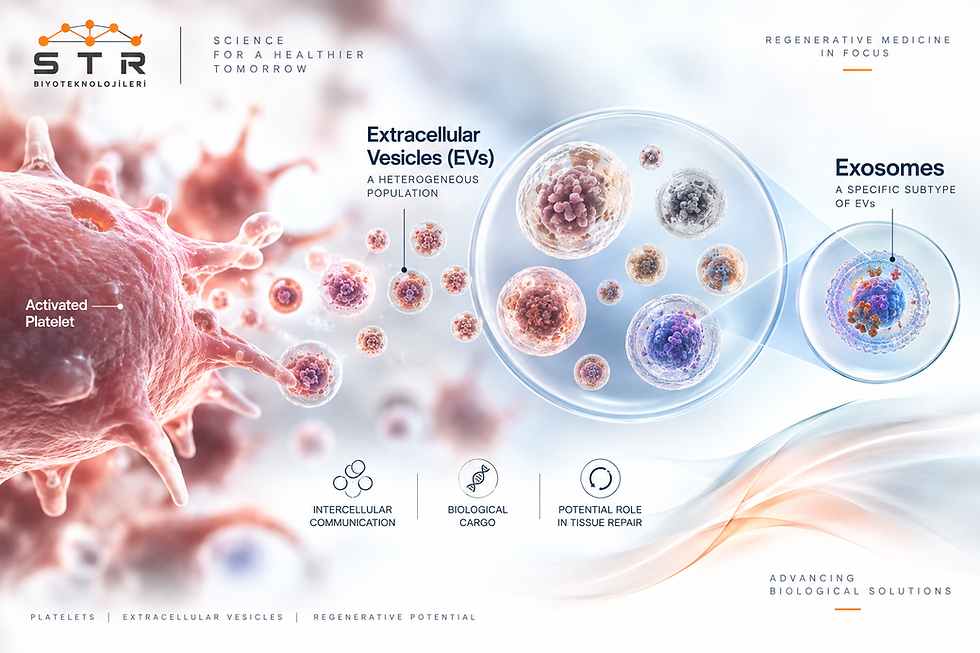
Extracellular vesicles (EVs) are membrane-bound particles released from cells, including platelets. Exosomes represent a biogenesis-defined subtype of EVs originating through the endosomal pathway.
Therefore, a particle population should not automatically be described as “exosomes” based only on particle size or concentration. Current MISEV2023 recommendations favor the broader term extracellular vesicles when specific biogenesis has not been demonstrated.
What Are Platelet-Derived Extracellular Vesicles?
Platelets are more than cellular components involved in hemostasis. Activated platelets can release extracellular vesicles carrying proteins, lipids, signaling molecules and other biological cargo involved in intercellular communication.
These particles are commonly referred to as:
Platelet-Derived Extracellular Vesicles — pEVs
Research into pEVs has expanded because of their potential roles in processes including cell signaling, angiogenesis, inflammation and tissue repair. However, clinical translation remains an emerging field and preparation and characterization protocols remain heterogeneous.
What Are Platelet-Derived Exosomes?
Exosomes are a specific subtype of extracellular vesicle defined by their cellular biogenesis.
They originate from the endosomal system and are released following fusion of multivesicular bodies with the cell membrane.
This distinction is important because:
Not every extracellular vesicle is an exosome.
Platelets can release heterogeneous EV populations. Therefore, identifying particles as exosomes requires more evidence than simply demonstrating the presence of nanoscale particles.
MISEV2023 specifically discourages using biogenesis-related terms such as “exosome” unless the origin of the EV population can be appropriately demonstrated.
Exosomes vs. Extracellular Vesicles
The simplest distinction is:
Extracellular Vesicles | Exosomes |
Broad biological category | Subtype of EV |
Released by many cell types | Defined by endosomal biogenesis |
Includes heterogeneous populations | Represents a specific biogenesis pathway |
Can vary substantially in size | Generally associated with small EV populations |
“EV” is preferred when origin is uncertain | “Exosome” requires stronger characterization |
Importantly, small EV and exosome are not synonyms. Different EV populations can overlap in size, and size-based separation alone cannot establish their cellular biogenesis.
How Are Platelet-Derived EVs Generated?
Platelet activation can trigger the release of extracellular vesicles.
A simplified biological pathway can be represented as:
Platelets → Activation → EV Release → Separation → Characterization
PRP can therefore serve as a platelet-rich starting material for investigating or preparing platelet-derived extracellular vesicle populations.
Research specifically examining PRP-derived EVs has expanded considerably, although differences in PRP preparation, activation, EV separation and characterization make direct comparisons between studies difficult.
Why Characterization Matters
One of the most important issues in extracellular vesicle research is determining what has actually been isolated or enriched.
Particle concentration alone cannot establish exosome identity.
EV characterization may involve complementary approaches evaluating:
Particle Size & ConcentrationTechniques such as nanoparticle tracking analysis can estimate particle size distributions and concentration.
MorphologyElectron microscopy can provide structural information.
Protein MarkersProteins associated with EV populations can be evaluated using appropriate analytical methods.
Cellular OriginPlatelet-associated markers can help investigate whether EV populations originate from platelets.
No single measurement is sufficient to fully characterize an EV preparation. This is why international EV guidelines recommend multiple complementary characterization approaches.
PRP-Derived EVs and Regenerative Medicine
Platelet-derived EVs are being investigated as biological mediators involved in regenerative processes.
Preclinical research has explored potential roles in areas including tissue repair, angiogenesis, musculoskeletal regeneration and cell signaling.
However, the field remains relatively early in clinical translation.
A systematic-narrative review of PRP-derived EV research identified substantial heterogeneity in preparation and characterization protocols and emphasized the need for standardized methods before results can be meaningfully compared across studies.
Therefore:
Promising biological evidence should not be interpreted as proof of universal clinical superiority over PRP or other regenerative preparations.
ExoPrime® and Platelet-Derived EV Preparation
STR Biotechnologies develops ExoPrime® as a platelet-derived biological preparation technology using PRP as the starting material.
The technological concept follows the pathway:
PRP Preparation → Platelet Processing/Activation → Particle & EV Release → Biological Preparation
From a scientific terminology perspective, distinguishing between particle concentration, extracellular vesicle populations and confirmed exosome identity is important.
This distinction allows platelet-derived technologies to be discussed within the evolving scientific framework of extracellular vesicle research while avoiding oversimplification of complex biological populations.
Conclusion
Platelet-derived exosomes and extracellular vesicles are closely related concepts, but they are not scientifically interchangeable.
Extracellular vesicle is the broader and generally preferred term when the precise biogenesis of a particle population has not been established.
Exosomes represent a more specific EV subtype.
As platelet-derived EV technologies develop, accurate terminology, standardized preparation and complementary characterization will be essential for improving reproducibility and scientific interpretation.
Editor’s Note
This content has been prepared based on current scientific literature and international peer-reviewed publications. It is provided for informational purposes only and does not constitute diagnosis or treatment advice. Clinical decisions should always be made by qualified healthcare professionals.
Related STR Products
ExoPrime® Platelet-Derived Exosome System — STR technology developed around platelet-derived biological preparations using PRP as the starting material.
HighCell® PRP Kit — Platelet-rich plasma preparation technology for controlled separation and concentration of platelet-containing plasma.
LABFUGE® Centrifuge — Centrifugation platform supporting regenerative medicine preparation workflows.
Related Blog Articles
ExoPrime® Technology: From PRP to Platelet-Derived Extracellular Vesicle Preparation
Platelet-Derived Extracellular Vesicles in Regenerative Medicine: What Does Current Evidence Show?
PRP-Derived Exosomes: What Determines Preparation Quality?
Scientific References
Welsh JA, et al. Minimal information for studies of extracellular vesicles (MISEV2023): From basic to advanced approaches. Journal of Extracellular Vesicles. 2024;13:e12404. DOI: 10.1002/jev2.12404.
Antich-Rosselló M, et al. Platelet-Derived Extracellular Vesicles for Regenerative Medicine. International Journal of Molecular Sciences. 2021;22(16):8580. DOI: 10.3390/ijms22168580.
Anitua E, et al. Advances in Platelet Rich Plasma-Derived Extracellular Vesicles for Regenerative Medicine: A Systematic-Narrative Review. International Journal of Molecular Sciences. 2023;24(17):13043. DOI: 10.3390/ijms241713043.
Burnouf T, et al. Expanding applications of allogeneic platelets, platelet lysates, and platelet extracellular vesicles in cell therapy, regenerative medicine, and targeted drug delivery. 2023. PMID: 37704991.
FAQ
Are platelet-derived exosomes and extracellular vesicles the same?
No. Extracellular vesicles are a broad category of membrane-bound particles. Exosomes are a specific EV subtype defined by their endosomal biogenesis.
Are all small extracellular vesicles exosomes?
No. Small EVs and exosomes are not synonymous because different EV populations can overlap in size.
Can platelets release extracellular vesicles?
Yes. Platelets release extracellular vesicles containing diverse biological cargo involved in intercellular communication.
Can PRP be a source of extracellular vesicles?
Yes. Activated platelets within PRP can release EVs, and PRP-derived extracellular vesicles are an active area of regenerative medicine research.
Is particle concentration the same as exosome concentration?
No. Measuring particle concentration alone does not demonstrate that every detected particle is an exosome. Appropriate EV characterization requires complementary analytical evidence.
Why is EV characterization important?
Characterization helps determine the properties and composition of the isolated particle population and improves reproducibility between studies and preparation technologies.